Skip to content
One-click ordering, AI-assisted taxi-hailing, AI clinics, AI restaurants, and over 50 other scenarios have been implemented…


Entering the AI・Mirror World – Nanjing Artificial Intelligence Ecological District located in China’s (Nanjing) Software Valley, the overwhelming “futuristic” atmosphere immediately comes into view.

In 2025, the scale of software and information services industry in Nanjing will exceed one trillion yuan, making it the first trillion-yuan-level industry landmark in the city. As the first road named after an industry in the country, the Software Avenue, which is 5.3 kilometers long, witnessed the launch of Nanjing’s software industry. Based on this point, the China (Nanjing) Software Valley, covering an area of 73 square kilometers, rapidly grew and became the main carrier of Nanjing’s software industry cluster. In 2025, the software business revenue contributed by the Yuhuatai District where the Software Valley is located reached 351.9 billion yuan, with a year-on-year growth of 19.3%, accounting for 35% of the city’s software industry cluster, providing strong support for Nanjing to achieve the goal of a trillion-yuan industry cluster.
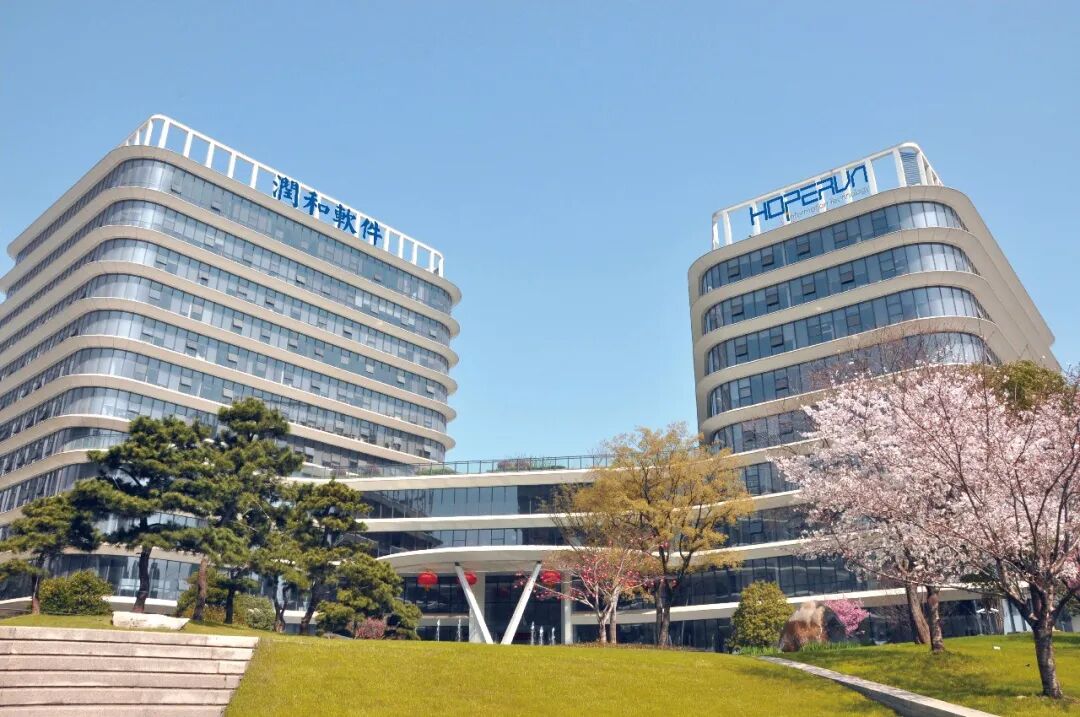
Recently, a group of journalists visited China (Nanjing) Software Valley to explore its past, present and future – the signs of progress, the footprints of pioneers. Jiangsu Hoperun Software Co., Ltd
In 2006, it was established (hereinafter referred to as “Runhe Software”) and it was one of the first enterprises to settle in the Software Valley and also the first listed enterprise in the Software Valley.
In 2009, Runhe Software moved to Software Avenue. Just one year earlier, Yuhuatai District renamed “Ningnan Avenue” as “Software Avenue” in an effort to enhance the influence of the software industry. The following year, Nanjing was awarded the title of the first “China Software City” by the Ministry of Industry and Information Technology. To build a high-standard “China Software City”, the China (Nanjing) Software Valley was officially inaugurated in August 2011.
As pioneers, many of Runhe Software’s veteran employees still remember the scene when they first arrived: the area was sparsely populated and transportation was inconvenient. However, changes came rapidly. As one after another tall buildings rose, industrial elements gathered rapidly, and more aspiring entrepreneurs flocked to the Software Valley.
In 2013, the digital freight transportation platform of Manbang Group, Yunmanman, wrote its first line of code here.
In 2015, Nanjing Vituo Technology Co., Ltd. (hereinafter referred to as “Vituo Technology”), which aimed to “create its own software for China’s industry”, moved its headquarters to the Software Valley at a crucial stage of its development.
In 2016, Yihui Information Technology Co., Ltd., which specialized in industrial operating systems (hereinafter referred to as “Yihui Information”), also established its regional headquarters here and embarked on its entrepreneurial journey in Nanjing. Why was it here?
A statement made by Gao Jing, the General Manager of Public Affairs of Manbang Group, captured the common sentiment of the enterprises: As early as 2001, Nanjing had proactively introduced special policies for the development of software and information service industries. Over the past two decades, facing the shifts in industry trends, Nanjing has continuously deepened its focus on the software sector and shaped characteristic advantageous industrial clusters. This “commitment to completing the blueprint” of determination has provided the most predictable development environment for technology enterprises. Additionally, from science and technology funds, industrial support, to housing for talents and office space support, multi-dimensional and systematic policy provisions have provided solid soil for the growth of enterprises. In response to new technologies and new business models, the government has also offered inclusive guidance and effective support. This governance approach, which is oriented towards effectiveness and based on trust, enables technology enterprises to dare to invest, dare to explore, and dare to act, concentrating on innovation without distractions.
Rainforests, “Innovation Density” Brings About Industrial Wonders
Today, in Yuhuatai District – a land accounting for only 2% of Nanjing’s total area – there are over 4,900 software enterprises and 370,000 software professionals.
This “tropical rainforest” style of innovative ecosystem, with its astonishing “per-acre yield” capacity, has created industrial wonders and continues to drive local enterprises to grow vigorously. At Weituo Technology, Chairman Yang Songgui showed the reporter a small “black technology” – “The 4th Generation Embodied Intelligent Welding Brain”. It equips the welding robot with a “smart brain”, which not only can control the quality and accuracy of welding through AI algorithms, but also can dynamically optimize costs based on different welding processes. The potential market size is estimated to reach tens of billions of yuan. Currently, Weituo Technology has successfully built several independent industrial software platforms, and its flagship product, the Digital Engineering Platform, has passed the information security certification and is fully compatible with domestic chips and operating systems. In the high-end equipment field, Weituo Technology, relying on its technical strength, has competed with international giants such as Siemens and Dassault, and has won multiple tenders. “Last year, the company’s revenue increased by nearly 40%, maintaining a good development momentum,” Hu Shaokai, the strategic development director of Yihui Information, revealed. From a founding team of 9 people in the initial stage to a company of 400 people now, Yihui Information has grown into a leading enterprise in embedded real-time operating systems in China. The core product, the large-scale industrial operating system SylixOS, has an internal kernel and core components with an autonomous rate of 100%, and its comprehensive performance reaches the international leading level, widely used in key fields such as aerospace, rail transportation, intelligent vehicles, and energy and power.

The strength of the innovative ecosystem lies in enabling enterprises to achieve a “genetic evolution” from technology to business. Li Na, the vice president of Jiangsu Ruheng Software Co., Ltd., introduced to the reporter that in the past year, Ruheng Software has grown steadily in innovative business areas such as open-source HarmonyOS, open-source Oros, and financial AI, accounting for more than 20% of the total revenue and becoming a powerful driving force for the company’s development. In the medical technology field, the company integrates cutting-edge technologies such as AI, quantum dots, and open-source HarmonyOS, and has globally launched the AI quantum dot microbial detection platform. This platform has shortened the microbial detection time from over 48 hours to within 30 minutes, and the accuracy has increased to over 90%. It has now been applied in scenarios such as hospital infection control, disease control centers, and biopharmaceuticals.
In the exhibition hall of Manbang Group, a huge data screen of the intelligent logistics “brain” operates day and night, continuously mapping out a vast digital freight network covering over 330 cities across the country and 110,000 routes. A large number of freight orders keep pouring in from all directions. Through the empowerment of artificial intelligence, big data and cloud computing technologies, Manbang has successfully solved the long-standing problems in the freight industry such as scattered transportation capacity, mismatched supply and demand, and lack of transparency in information, and has comprehensively improved the operational efficiency of the social logistics system.

Currently, Software Valley has formed a complete chain spanning from foundational software and industry-specific applications to platform services, with various enterprises closely interconnected and mutually nourishing like symbiotic plants. Looking across Nanjing, the core Software Valley—alongside six provincial-level or higher key software parks such as the Nanjing Jiangbei New Area Industrial Technology R&D Park and the Jiangsu Software Park—constitutes a multi-point supported, regionally interconnected industrial new layout, propelling Nanjing’s software industry competitiveness to new heights.
Riding the wave, Nanjing is advancing into the deep waters of “AI+.”
Standing at the new starting point of a trillion-yuan industry, Nanjing’s software enterprises have already set their sights on the next battlefield—artificial intelligence.
At the beginning of the new year, Nanjing released the *Several Policies on Accelerating the Cultivation of New Quality Productive Forces to Promote High-Quality Development (2026 Edition)* (hereinafter referred to as the Several Policies), prioritizing the construction of a national advanced manufacturing base. It proposes strengthening national-level advanced manufacturing clusters such as software and information services, providing financial support for projects in information technology application innovation industrialization, open-source commercialization, software adaptation for HarmonyOS, and industrial software. Simultaneously, the Several Policies calls for the implementation of the “AI+” action plan and the high-standard development of an upgraded version of the National AI Innovation Application Pilot Zone.
Gao Jing describes the Several Policies as a “timely rain,” driving the deep integration of software as a “foundational base” with artificial intelligence and industrial technology. “As a local enterprise born, rooted, and developed in Nanjing, our company will also follow the guidance of the Several Policies, comprehensively advance the ‘AI + Logistics’ strategy, fully devote ourselves to cultivating new quality productive forces, and build a secure, efficient, and emotionally connected digital freight ecosystem, living up to the foresight, support, and trust of this city,” she said.
Runhe Software has established a “dual leap” strategy: breakthroughs in traditional businesses and innovations in new ventures. The company will focus on strengthening five pillar businesses: open-source HarmonyOS, open-source Euler, financial globalization, digital energy, and healthcare technology. Additionally, as a leading enterprise and deep co-builder in the HarmonyOS ecosystem, it will play a central role in Nanjing’s efforts to build a “HarmonyOS Pioneer City.” More imaginatively, Runhe Software has identified “embodied intelligence” as a new key technological development strategy, aiming to create a nationally leading ecosystem for control brain systems for industrial, service, and other forms of robots, deeply participating in the intelligent new ecosystem of robotics.
Looking to the future, Weituo Technology’s strategic ambition is to evolve industrial software from a “tool” into an “intelligent agent” with decision-making and learning capabilities. “Our goal is to extend AI agents from the R&D and design stages to the entire process of production, after-sales service, and smart operations, fundamentally reshaping the value innovation model of AI industrial software,” said Yang Songgui.
Yihui Information is actively promoting the deep integration of new-generation information technologies such as artificial intelligence and edge computing with operating systems. Through close collaboration with upstream and downstream enterprises in the industrial chain, it aims to build an open and collaborative intelligent ecosystem. “Let technology take root in industrialization,” Hu Shaokai emphasized. “The true vitality of an ecosystem always lies in its ‘usability.’ We will rely on the positive reputation of our products to make domestically developed industrial operating systems a more solid digital foundation in the AI era.”
Nanjing is leveraging unprecedented institutional innovations to build an AI innovation hub deeply integrated with talent, industry, and the city. Last year, Nanjing established the Artificial Intelligence Industry Promotion Office to strive for a competitive edge in the new round of industrial competition. On January 27 this year, the Yuhuatai District Artificial Intelligence Development Bureau was officially inaugurated, becoming the first district-level AI administrative department in Jiangsu Province included in the party and government institutional sequence and equipped with specialized administrative staffing. Yuhuatai District has now built the province’s first AI ecological street, gathering 381 AI-related enterprises with over 50,000 employees and achieving an industrial revenue of 18 billion yuan in 2025.
The path ahead is broad and unwavering, with travelers knowing no bounds. A new journey has begun—this road continues to extend forward, and this city is creating new history.