Skip to content
Recently, the stock options held by the National University Biomedical Regional Technology Transfer and Transformation Center (located in Nanjing, Jiangsu Province) (referred to as the “sub-center”) of Nanjing Ningji Biomedical Technology Co., Ltd. were successfully registered and entrusted on the Equity Trading Platform of Jiangsu Province.
“This is equivalent to completing the ‘registration and certification’ on a nationally recognized platform,” said Xu Tong, the director of the Investment Promotion Department of the sub-center. This registration and entrustment also means that the first “patent industrialization + stock options” integration model in the province has been successfully implemented, opening up new paths for the transformation of scientific and technological achievements and enterprise financing innovation.

What is this new model of “patent industrialization + stock options”? What innovative story lies behind the first such case in the entire province?
01
Nanjing Ningji Biomedical Technology Co., Ltd. is the industrialization entity of Professor Chu Yong’s team from Fudan University. It is dedicated to solving the clinical problems of primary immune thrombocytopenia.
Primary immune thrombocytopenia is an autoimmune disease. Due to autoimmune factors, the number of platelets in the body decreases. Common symptoms include purpura, nosebleeds, even gastrointestinal bleeding, intracranial bleeding, etc. For a long time, patients’ treatment has relied on hormones or hemostatic drugs, with significant side effects and a high risk of recurrence after discontinuation.

Is there an innovative drug that can go from “treating the symptoms” to “treating the root cause”? Through long-term research, Chu Yong and his team have made a new discovery. They have clearly identified GSK-3β as the key target for treating this disease – it can regulate macrophages and reduce platelet destruction; it can also affect megakaryocytes and promote platelet production, directly targeting the core of the pathology.
There is a new direction for disease treatment. While being pleasantly surprised, questions also arise: How can the laboratory’s innovative achievements be industrialized? Where will the funds come from?
“Early-stage research involves many risks. If the funds are limited, we can only bet on the possibility of one of the multiple candidate molecules.” Chu Yong admitted. At the “first kilometer” of this transformation, if not advanced, the results can only remain in the papers; but if it is advanced, from confirming the preclinical candidate molecules to submitting the new drug clinical application, the project will face a funding gap.
02
At a time of dilemma, a cooperation invitation from the north provided a new opportunity.

During a project presentation event at Fudan University, the branch center came into contact with the Chu Yong team. “Target mechanism innovation, significant immune regulation efficacy, and in-depth participation of clinical experts – these are precisely the types of support most needed for early transformation,” Xu Tong recalled. After a professional technical assessment, the branch center decided to support the team in realizing their transformation.
At that time, just as the Jiangsu Provincial Intellectual Property Bureau and the Jiangsu Provincial Local Financial Management Bureau jointly issued the “Jiangsu Province ‘Patent Industrialization + Stock Option’ Work Plan”, exploring the “patent industrialization + stock option” model. The branch center thus presented a unique “transformation gift”.
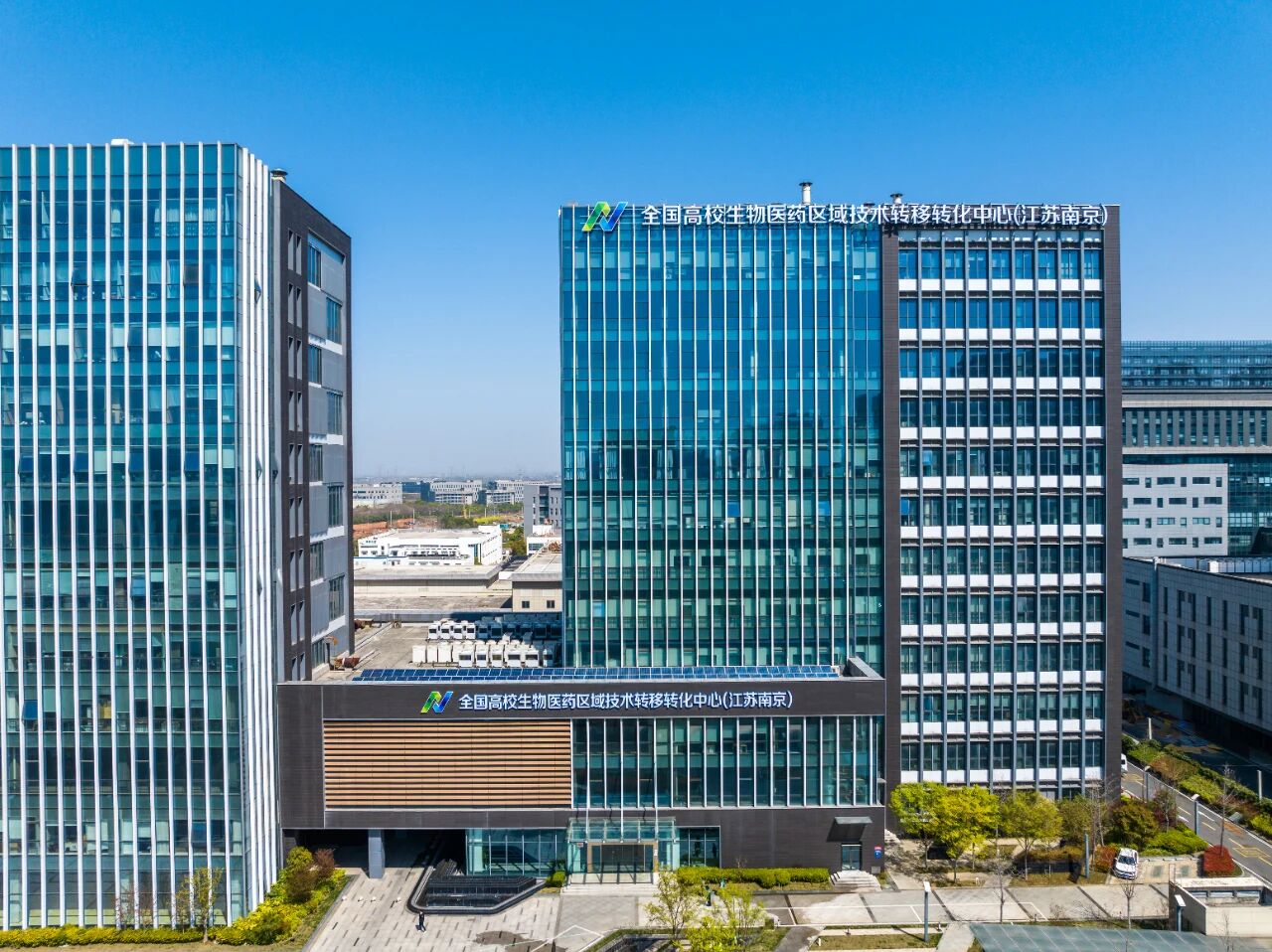
“The ‘gift’ consists of three parts,” Xu Tong explained. The first part is financial support in the form of real money, where the center provides start-up funds for early projects and injects hundreds of millions of yuan of special support into the team. The second part is service support, where the technical advisors of the center help the Chu Yong team jointly formulate the project development plan, including setting milestone nodes, connecting with CRO enterprises, etc. Each step has dedicated personnel for follow-up, ensuring compliance with the requirements of new drug research and development.
The third part is the most innovative part – the center converts the early investment in the project into “stock options” for the enterprise. This means that the center currently provides financial and technical support for the transformation of the project without requiring immediate acquisition of equity or repayment of dividends. Instead, it exchanges for a future right. Once the enterprise grows and its value increases, the center can obtain the corresponding equity at the current agreed price.
“Both financial and service support, without having to give away a large amount of equity at the lowest valuation stage,” Chu Yong said. Such support enables the team to focus solely on the transformation.
In the view of the staff of the center, this model brings about a “win-win” situation. “Everyone shares the risks and jointly transforms,” Xu Tong said. When the research team and the transformation platform become “companions”, it not only promotes the industrialization process of cutting-edge biopharmaceutical technology but also forms a sustainable value return mechanism, achieving efficient linkage of “technology – capital – industry”.
03
Nowadays, the equity options held by the branch center for Jingqi Biotechnology have been registered and entrusted at the Equity Rights Comprehensive Service Platform of Jiangsu Equity Exchange Center, providing a guarantee for future rights exercise.
Located at Fudan University School of Pharmacy, Professor Chu Yong and his team have successfully completed the PCC stage verification of the small molecule candidate drug YC-4-3. The industrialization process is accelerating, and it is expected to bring safer and more effective oral innovative drugs to patients.
The first “patent industrialization + stock option” integration model in the province was successfully implemented in Jiangbei. Behind this is a vivid story of “accompanying the transformation process”. As a bridge connecting the technology chain and the industrial chain, in order to better promote the transformation of university scientific and technological achievements into real productive forces, the sub-center’s exploration does not stop here –
The province’s first university-based technology transfer angel fund, with a total scale of 500 million yuan, has invested in several projects, reducing the barriers and improving the efficiency of technology transfer. It has specially customized the “Technology Transfer Loan” with Jiangsu Bank, providing support up to 30 million yuan through the innovative “Loan upon Signing” method. In collaboration with Nanjing Bank, it has launched the “Research and Development Pipeline Loan” to help projects convert intellectual property into actual assets… A series of innovative measures are now safeguarding the entire chain of university technology transfer, promoting more research results from laboratories to production lines.
In the future, the branch center will continue to adopt the “patent industrialization + stock options” model to stimulate the innovative spirit of scientific researchers and attract more social capital to pay attention to and invest in early-stage technological innovation,” Xu Tong said.