Skip to content
The low-carbon Technology office building of Jiangsu Provincial Institute of Building Research, located at No. 107, Hongshan Road, Xuanwu District, has been officially put into use. As one of the fourth batch of urban renewal pilot projects in our city, it can not only generate green electricity by itself through an “ecological skin”, but also precisely save energy with a “smart brain” to achieve the goal of a nearly zero energy consumption building.
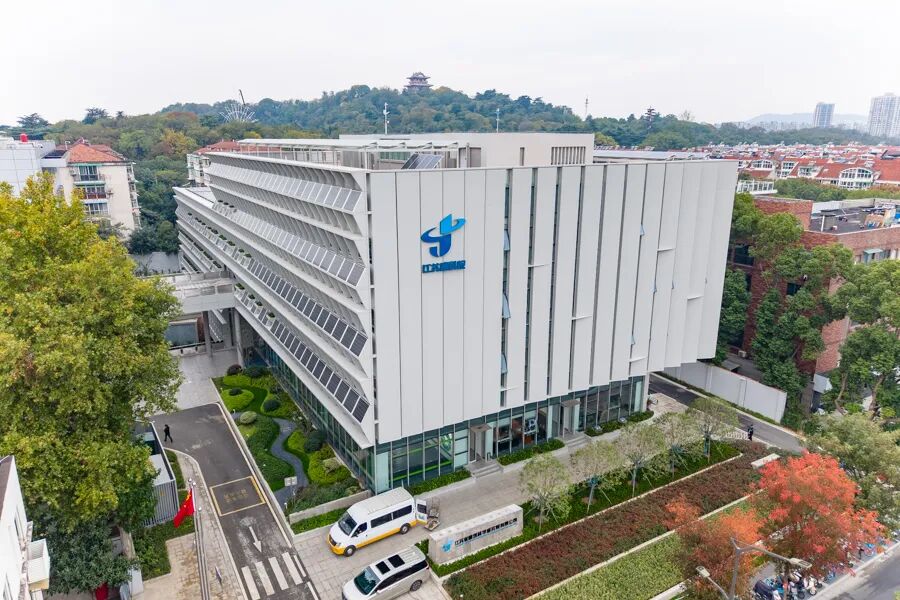
The low-carbon Technology office building of Jiangsu Institute of Building Research is adjacent to Hongshan Zoo, with a total land area of approximately 6,783 square meters. As a provincial and municipal urban renewal pilot project, the project adheres to a full-life, systematic low-carbon design concept and applies a variety of green and low-carbon specialized technologies. It has obtained multiple certification labels such as three-star green building, Gold-level healthy building, and near-zero carbon building. It is estimated that the total carbon emissions throughout the building’s life cycle will be reduced by one-third compared to conventional buildings, and the carbon emission intensity during the building’s operation stage will be reduced by approximately 68%.
The ecological epidermis efficiently “absorbs” sunlight

Entering the Institute of Building Science, the first thing that catches the eye is its highly technological facade – photovoltaic panels and green plant troughs are interwoven in a staggered manner, forming a picture of modern architecture coexisting with nature. This unique design is called “ecological skin” and has the functions of saving electricity and generating carbon sinks.

The installation Angle of the photovoltaic panels has been precisely calculated to maximize the utilization of solar energy throughout the year. The project leader introduced, “In areas with abundant sunlight, we use solar panels to convert the energy of sunlight. In some areas with low power generation efficiency due to shading, we utilize plants to fix carbon through photosynthesis, creating a three-dimensional carbon-reducing building ‘coat’ that is aesthetically pleasing, highly technological, and close to nature.”
Low-carbon renewal of existing components for recycling benefits

The project takes the atrium with the collective memory of the old factory building as the spatial core. During the renewal process, it integrates three types of buildings: demolition and utilization, renovation, and new construction, avoiding the “large-scale demolition and construction” model, maximizing the activation of space and enhancing the value of land use.

The roof truss of the original experimental workshop, after protective demolition and reinforcement, has been rejuvenated on the top of the new lecture hall. The reaction wall representing the corporate culture was cut and placed at the main entrance, becoming a brand-new Logo wall. The scissors braces of the old factory building were transformed into railings, the removed red bricks were used to build non-load-bearing walls, and the old train tracks, after being cut off, were turned into a garden nursery and seats… According to estimates, the reuse of existing components can reduce carbon emissions by over 40% during the demolition stage of old buildings.
The photovoltaic storage direct flexible system generates 200,000 kilowatt-hours of electricity independently each year


The project utilizes photovoltaic storage direct flexible technology to flexibly adjust the building’s electricity demand, enabling real-time matching of building electricity with clean energy power generation
The roof and the south facade of the building are equipped with solar photovoltaic panels with a total installed capacity of 238 kilowatt-hours, which are composed of 406 pieces of monocrystalline silicon. The photovoltaic panels on the roof also innovatively adopt an automatic daylight tracking system, ensuring that the panels always face the sun at the best Angle and absorb sunlight with the highest efficiency.
We have applied cadmium telluride photovoltaic power generation glass to the skylight on the top of the building, which can not only provide light but also generate electricity. The project leader introduced, “By adopting this building-integrated photovoltaic technology, the building can generate about 200,000 kilowatt-hours of electricity independently each year, accounting for one-third of the entire building’s electricity consumption, and the proportion of renewable energy application exceeds 30%.”
Smart operation and maintenance of “breathing” office Spaces

Carbon reduction intelligence is not confined to the construction stage. The project is equipped with an independently developed “smart brain” – the building smart operation and maintenance system. It enables buildings to “perceive” their own energy consumption and environmental data, and “intelligently” autonomously optimize their operation strategies. The system, through AI algorithms, achieves precise control over air conditioning, lighting and other equipment, such as automatically adjusting the fresh air in the area and turning off unmanned devices, thereby further reducing operational energy consumption by 5% to 10% and ensuring continuous green efficiency.
Guided by the gold-level standard for healthy buildings, the construction entity adopts adjustable external shading, high-efficiency HVAC equipment, and indoor environmental quality monitoring technologies to achieve an indoor temperature fluctuation of no more than 1℃ and a carbon dioxide concentration of less than 800 parts per million. The atrium courtyard brings in natural light, complemented by a green plant wall and a silent fresh air system, creating an office space that “breathes”.

From the energy conservation and carbon reduction of the “ecological skin” to the recycling and regeneration of old components, and then to the precise control of intelligent operation and maintenance, the renovation of the low-carbon technology office building of Jiangsu Institute of Building Research is not only the transformation of a building, but also a microcosm of the deep integration of urban renewal and the “dual carbon” goals.
Our city will gradually form replicable, referential and promotable experiences in urban renewal and low-carbon building construction management, providing models and guidance for the creation of similar demonstration projects in the future. Source: Nanjing Construction.