Skip to content
This year’s provincial government work report stated that it would support the innovation and entrepreneurship of artificial intelligence OPC, making “single-person companies” become widespread. In Jiangsu Province, starting from Suzhou’s pioneering layout of the OPC (One Person Company) innovation ecosystem, a wave of innovation community construction centered on “one-person companies” has rapidly spread. From the implementation of top-level policies to the formation of physical spaces, from individual sporadic trials to the construction of an ecosystem, a new proposition related to youth entrepreneurship, urban innovation, and the future of industries has emerged before us: How can OPC communities support the “super individuals” scattered throughout the city? And how will they reshape the regional innovation and entrepreneurship ecosystem?

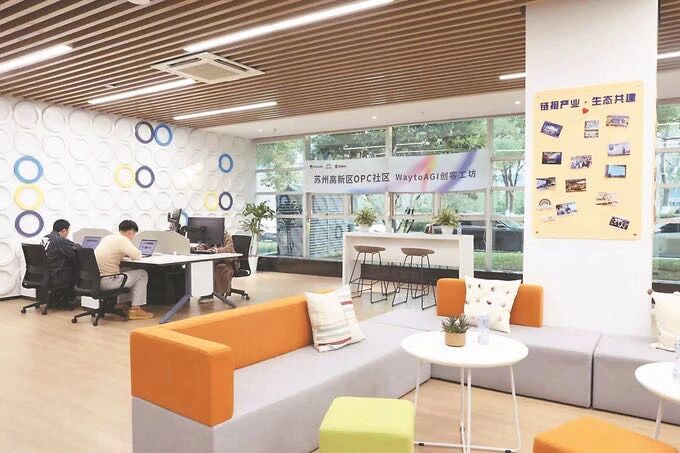
Overcoming difficulties and creating a new service model This Spring Festival holiday, entrepreneur Wang Peng was busy at his workstation. Before the holiday, he completed the registration and establishment of a “single-person company” in the Qipin OPC community in Huihe Central Science and Technology Zone of Nanjing City in just one day. He used to be the technical director of an internet enterprise, holding self-developed products of an intelligent outbound call system, but he once got stuck in the real-life bottleneck of individual entrepreneurship. “To start a company, you need to connect with countless aspects such as industry and commerce, taxation, legal affairs, channels, and resources. One person has to do the work of ten people.” He admitted that individual entrepreneurs often fall into the “all-capable trap” – they have to tackle core technologies while also being consumed by trivial matters, ultimately resulting in slow progress and even the stagnation of ideas. Such a predicament is not an isolated case. Doctoral student Chen Yawei from Nanjing University and the founder of “Le Orange Zhi Kang” has a deep understanding of this. Before joining the OPC community, although he had technical reserves in the direction of AI medical rehabilitation, he was constrained by insufficient computing power, scarce resources, and cumbersome processes, and his product was unable to advance. Now, his AI tumor rehabilitation assistant APP has been scheduled to start an internal test in March this year. “The OPC community provides a large-scale factory-level technical platform, millions of computing power subsidies, and a full-process integrated service of ‘opening in one day’, allowing me to focus all my energy on research and development,” Chen Yawei said. His words reveal the core value of the OPC community: to relieve “super individuals” and let professionals do professional work. From being trapped by high costs, high thresholds, and lack of resources, to lightening up and quickly implementing, the entrepreneurial trajectories of Wang Peng and Chen Yawei have changed, which is a vivid illustration of the rise of the Jiangsu OPC ecosystem. In the current era of comprehensive penetration of AI technology, “single-person entrepreneurship” is no longer just an illusion, but the gap between individual strength and organized resources remains the biggest obstacle. “The logic of the industrial age is to organize people into enterprises, while the logic of the AI age is to enable individuals to have the same capabilities as organizations.” Zhang Fan, an expert in recruitment and training at Zhaopin, who has long been concerned with human resources and technology venture capital, believes that the essence of the OPC community is not simply to provide office spaces, but to break through resource barriers and allow a single individual to share the computing power, capital, scenarios, and ecosystem of large enterprises, which is a completely new entrepreneurial service model. He found that the Jiangsu OPC community has taken on a pattern of leading in the south and blooming in multiple locations, initially forming differentiated paths such as entrepreneurial incubation, technological innovation, and industry-specific ones. However, at the same time, how to break away from the traditional incubator thinking and strengthen service supply with new concepts and new systems determines whether the OPC community can go far and be practical. Understanding the group can lead to precise services. Hu Jinhua, the chairman of Suzhou Xianggao High-tech Investment and Promotion Co., Ltd., participated in the planning and operation of the OPC carrier of Suzhou Artificial Intelligence Park throughout. After in-depth contact with a large number of entrepreneurs, she has a clear judgment of the OPC group: “It is completely different from traditional individual entrepreneurs. They are mostly college students, key employees of large companies, and industry geeks, focusing on hard-core fields such as AI education, intelligent hardware, medical technology, and large model applications. They don’t lack a desk, but they lack computing power, scenarios, channels, and industrial chain connections, which are high-value resources.” Based on this judgment, many OPC carriers in Jiangsu have moved beyond the low-end supply of “space leasing” and turned to value empowerment. The reporter’s investigation found that many parks are formulating new operation evaluation systems, listing scenario connection, industry mentors, ecosystem activities, cross-border collaboration, and technology transfer as core indicators, forcing the operators to break away from the framework of traditional parks and investment promotion platforms and transform from “landlords” to “ecosystem service providers”, providing full-chain and one-stop support for “single-person entrepreneurship”. Merging “neighborhoods” and creating naturally occurs. A suitcase, a set of fragrance tools, a computer, and a set of large model tools are all that entrepreneur Yee’s “possessions”. With her self-developed AI aroma matching model, the AI fragrance blending brand she created has covered 30+ cities, connecting hundreds of creators and university communities, and building a lightweight yet efficient entrepreneurial network. “The OPC community in Suzhou High-tech Zone helped me establish the first batch of city partners, and also helped me find engineers and designers as partners at the salon.” Yee showed the reporter her “virtual team”: AI is responsible for algorithm analysis, OEM factories are responsible for production, offline collaborators are responsible for experience and feedback, and she only needs to hold onto the core model and brand style. One person, one AI, one ecosystem – this has completed the business that traditional companies need dozens of people to operate. This is precisely the unique charm of the OPC community: it is not a closed office space, but a key hub connecting individual creativity with the industrial ecosystem, maximizing the release of individual creativity. What is more worthy of attention is the chemical reaction of “space as a scene” – upstairs is technology research and development, downstairs is application scenarios; across the table are entrepreneurs from different fields, and by turning around, cooperation can occur. This high-density, open cross-border bonding effect has become the unique advantage of the OPC community compared to traditional incubators. Entering the “Light Point Pi” OPC community in Yangzhou Mingyue Lake, the fully open layout, non-segregated workstations, and随处可见’s collision angles’ make it refreshing. Community Operations Director Chen Jingjing pointed at the ‘collision angles’ and told the reporter, “The frequent stories here are that ‘visiting each other leads to cooperation opportunities’.” Not long ago, a young entrepreneur developing teaching programs for teenagers and an upstairs neighbor engaged in IP operation happened to chat and jointly created a popular online technology account. Within just two months, 15 cross-border collaborations were independently developed within the community. “What independent entrepreneurs lack the most is not the space for solitude, but the immediate inspiration collision, resource connection, and person-to-person link.” Chen Jingjing said, “The space design of the community is essentially designing ‘the probability of cooperation’, making resources flow and creativity collide. ” Many interviewed experts and practitioners have stated that the value of the OPC community goes beyond the physical carrier. It is more like a “connector” and “converter” for resource flow, achieving internal resource circulation and industrial chain collaboration through designing ecological rules. The reporter’s investigation found that a batch of pioneering OPC communities in Jiangsu have broken through the primary model of “workstations + shared meeting rooms”, building a full-chain enabling system of “computing power supply + business services + industrial connection + cross-border collaboration + cloud-based collaboration”. Nanjing Qinying OPC has created a cloud platform to realize the one-click invocation of remote computing power and collaboration tools; Suzhou Huannan University Science and Technology Innovation Circle OPC community has connected the university’s research resources with individual creativity, promoting the rapid transformation of scientific research results in “the smallest unit”; Wuxi Liangxi District has launched the AI OPC , distributing “computing power coupons”, “model coupons”, and “data coupons”, with a maximum support of 10 million yuan in computing power costs, directly addressing the core pain points of entrepreneurs.
Some pioneering regions also encountered hidden problems earlier. An observer who has been deeply involved in the technology incubation field for over 10 years told the reporter that currently, the development of the OPC community in Jiangsu is not balanced. A few leading carriers have achieved a complete operational loop of “single person + AI”, but more carriers are still stuck in the shallow mode of “renting workstations and providing computing power”. Problems such as insufficient computing power allocation, insufficient industrial integration, incomplete service systems, and unconnected connection channels are prominent. Entrepreneurs still “can’t find scenarios, can’t get orders, and can’t obtain funds”, and the empowerment effect is greatly reduced. “OPC is not just simple ‘single-person office’. If it cannot be embedded in the industrial chain and integrated into the industrial ecosystem, even the most fancy space design is just water without a source.” The person said. Rationally deepening and returning to the essence of entrepreneurship, from the intensively issued policies to the continuous attention of capital, from the proliferation of carriers to the enthusiastic of entrepreneurs, the OPC sector is now experiencing a rapid development period. Amid the craze, more rational thinking and calm judgment are needed: How to avoid hasty expansion and homogenized competition? How to prevent the OPC concept from becoming a bubble? How to make “one-person companies” truly create value and contribute to the real economy? A venture capital institution practitioner said that currently, some regions’ OPC communities have shown early warning signs: The vacancy rate of workstations is high, and theprojects mostly concentrate on low-tech content industries such as e-commerce . They are far from the positioning of AI OPC. Some carriers have outdated operation models, and so-called industrial empowerment and ecological collaboration are just formalities. There is also blind follow-up layout in some regions, lacking industrial foundation and resource support, and ultimately falling into homogenized competition. Regarding this, local government departments and operators have reached a consensus: OPC communities must be rooted in industries and serve the real economy, and must firmly abandon the “landlord” mindset, and take the path of differentiation, specialization, and value creation. “The development of OPC in various regions actually has no unified template. The differences behind them are the different industrial foundations and resource endowments.” A relevant official from the Data Bureau of Yangzhou City gave an example, saying that Yangzhou, based on its local advantages such as intelligent manufacturing and smart tourism, has opened up urban application scenarios, allowing OPC projects to have places to land, scenarios to use, and markets to expand, truly achieving synchronization with local industries. Moving towards rational deepening, a number of OPC communities have established strict project entry and dynamic cultivation mechanisms. Yangzhou’s Mingyuehu “Light Point Pi” OPC community adopts a “dynamic screening + layered empowerment” model, not considering education level, background, or business plan, but focusing on assessing the technical implementation ability and potential for scene integration; Nanjing’s Jianye District’s Qinying OPC community, through the initial review of plans, regular growth discussions, and periodic review and assessment, precisely screens high-growth projects, continuously optimizes service supply, and enables truly innovative “super individuals” to stand out. Local competition in the OPC sector is also a two-way pursuit of talents and industries. OPC, as a lightweight, high-efficiency, and highly flexible innovation unit, is becoming an important means for various regions to attract young talents and layout future industries. The reporter noticed that many places in Jiangsu have already “tailor-made” support systems for OPC in their talent policies. Yangzhou has introduced “10 Measures for AI Talents” and “10 Measures for Digital Talents”, and OPC entrepreneurs, in addition to enjoying inclusive policies such as housing subsidies, living allowances, and children’s education, can also receive full-chain support such as carriers, computing power, scenarios, research and development, transformation, and investment, with a single amount reaching up to 10 million yuan. Suqian has set aside the OPC track in its municipal key talent introduction project, and the selected projects can receive a maximum of 5 million yuan in funding. “What we aim to build is not a simple office community, but a comprehensive platform based on the digital soil of Suqian, rooted in the ecological of leading enterprises, and serving the smallest innovation units.” A relevant official from the Talent Department of the Suzhou Municipal Committee of Organization stated that the ultimate goal is to enable skilled and creative talents to complete the verification of their ideas, project incubation, and business growth at the lowest cost and with the fastest speed. Eventually, they will contribute to the local digital economy cluster, forming a virtuous and symbiotic cycle where “talents succeed in entrepreneurship and industries undergo vigorous upgrading”.