Skip to content
As a new type of cultural industry that integrates culture and technology, micro-dramas have been included in the national “15th Five-Year” planning outline and have become an important part of the new popular literature and art.
Recently, the Feiyan Network Audio-Visual Industrial Park in Lishui, Nanjing officially opened. This park focuses on the full-chain development of micro-dramas and provides “one-stop” professional services. It has formed a “one base and one park” linkage development pattern with Jiangsu Radio and Television Shiujiao Film and Television Base.

More than 20 shooting scenes transform an old factory into a “micro-drama dream factory”
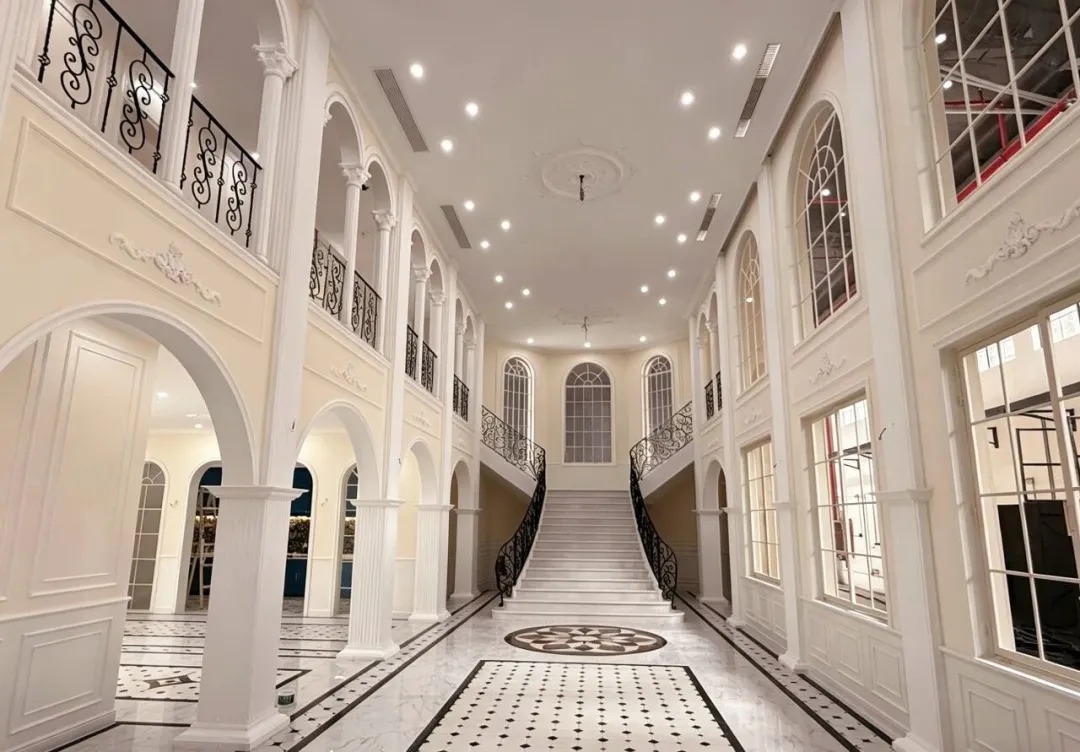
“President’s Office”, “French-style Villa”, “Interrogation Room”, “The House from the 1990s”… In the Lishui Feiyan Cultural District, a series of old factories have been transformed through renovation and have “transformed themselves” into shooting locations for various film and television productions.

In the actual scene of a real hospital ward, the crew of “Human Little Joy – New Life” is filming. In the spacious “ward”, three camera positions and other staff members such as the script supervisor are all present. In the adjacent room, the director is closely monitoring multiple screens, real-time coordinating the camera language and emotional focus.
“The scenes here are concentrated, the facilities and services are excellent, and there are dedicated personnel for coordination, allowing us to focus easily on the shooting,” said Mao Dou, the director of “Human Little Joy – New Life”. He began to shift to shooting vertical short dramas in 2023. Previously, he shot in Beijing, Xindu, and other places. At the end of last year, he came to Lishui. So far, he has completed the shooting of more than ten dramas.

The old factory has been transformed into a “micro-drama production base”, and the industrial relics have regained new vitality. Yu Wei, the deputy secretary of the Party Committee and the general manager of Lishui Industrial Group, introduced that the Feiyan Cultural District was originally the site of one of the “five golden flowers” of Lishui’s manufacturing industry in the 1990s, the former site of Nanjing Feiyan Piston Ring Factory. Now, it has become a new cultural landmark of Lishui. In October last year, Lishui District initiated the construction of a network audio-visual park, converting three old factories into over 20 high-standard live-action sets, which meet the current demands for shooting high-quality micro-dramas. The total area exceeds 6,000 square meters.
The “one base, one park” layout has established a complete ecosystem for short videos.
Lishui boasts a long history and culture, rich red culture, and beautiful landscape culture, which provides unique cultural resources for the development of online audio-visual industries. At the same time, it has 5 universities located in Lishui, such as Nanjing Forestry University and Nanjing Visual Art Vocational College. It is backed by 54 universities in the main urban area of Nanjing and over 1 million students on campus, which can provide talent support for the development of online audio-visual industries. Moreover, the Jiangsu Radio and Television Shiujiao Film and Television Base, which has been established in Lishui for 20 years, provides an industrial foundation for the development of online audio-visual industries.

The Nanjing Yanlai Film and Television Technology Co., Ltd., which has registered in the Lishui Feiyan Network Audio-Visual Industrial Park, specializes in providing all-round shooting support services for micro-dramas. The general manager of the company, Liu Hongliang, explained that the park can offer “one-stop” services covering all scenarios and all links for the filming teams that move in.
In addition to real-scene shooting, the integration of AI short dramas and virtual shooting has become a major feature of the Lishui Feiyan Network Audio-Visual Industrial Park. Yu Wei stated that this will significantly reduce the shooting costs for the filming teams that move in and improve the efficiency of content generation.
Launch the “One Hundred Books Initiative” to present a package of support
At the opening ceremony, Dong Yunchu, the former first-level inspector of the Network and Audio-Visual Department of the National Radio and Television Administration, delivered a keynote speech. He stated that the current micro-drama ecosystem is evolving towards five major trends: upgrading of content value, technological reconstruction of production, improvement of production standards, globalization and IPization, and maturation of policies and ecology. The market has shifted from “advertising and traffic dominance” to a stage of quality competition. The market size has continued to rise, and it is expected to exceed a new high this year, reaching 120 billion yuan.
As an important node city in the Yangtze River Delta and a world literary capital, Nanjing has become a “strong magnet” for the micro-drama industry, with over 1,000 micro-drama works released annually. Last year, the Nanjing Micro-Drama Industry Alliance was established, and the Nanjing “Good Drama Micro-Drama Service” mini-program was launched, promoting the formation of an ecological system for the entire chain empowerment and all-element guarantee in the Nanjing micro-drama industry. The Lishui Feiyan Network Audio-Visual Industrial Park was opened, injecting new momentum for the high-quality development of the city’s micro-drama industry.
It is reported that since the Shuilv Feiyan Network Audio-Visual Industrial Park began its trial operation at the beginning of this year, it has cumulatively hosted 26 filming teams and driven direct consumption of 4 million yuan. At the event, Shuilv officially launched the plan for 100 micro-dramas.
To attract filming teams to settle in the park, Shuilv has provided substantial financial support. According to the “Trial Measures for Supporting and Rewarding the Development of Network Audio-Visual Industry in Shuilv District”, Shuilv will offer support in multiple dimensions such as shooting location discounts, enterprise relocation, and high-quality creation. Among them, enterprises will receive a maximum 30% subsidy for computing power procurement, with the annual subsidy reaching up to 2 million yuan; for network audio-visual works created by local enterprises as the first producer and winning national permanent literary and artistic awards, the maximum reward is 200,000 yuan.