Skip to content
AI large models do extensive reasoning day and night, 5G base stations handle massive amounts of data, and computing centers with thousands of cards operate in a roar… If computing power is compared to a fast-beating “heart”, then what truly delivers energy to every transistor and enables signals to run smoothly across thousands of circuit boards without loss, is an “artery” that is almost invisible to the naked eye: high-end electrolytic copper foil.
It is so thin that it is only about one-tenth the thickness of a hair. It is deeply embedded between the layers of a printed circuit board (PCB). The key formula and manufacturing technology for this “blood vessel” had long been in the hands of Japanese and Korean companies. Now in Lishui, a cross-disciplinary doctor is leading a team to turn this “blood vessel” into something made by the Chinese themselves.

“Leaving the profession halfway through?” Actually, it’s “a long-term plan all along.”
In Lishui Economic Development Zone, a crucial piece of the puzzle in Nanjing’s new materials industry map, Longdian Huaxin’s East China headquarters base has been established here.
Wang Shengxian, a doctoral graduate from the Polymer Department of Zhejiang University and the executive vice president of Longdian Huaxin Nanjing Research Institute, entered the copper foil industry unexpectedly in 2023. Within just three years, he led his team to overcome multiple “critical technology bottlenecks”, enabling domestic high-end copper foil to truly enter the global supply chain.
Majoring in polymer science, why did he switch to researching metal materials? In response to this question, Wang Shengxian was very calm: “It may seem like a cross-disciplinary move, but in fact, it’s a continuation of the same line of work.”
It turns out that this person, born in Yancheng in 1969, delved deeply into the field of metal corrosion and protection during his doctoral studies at Zhejiang University in the 1990s. The essence of metal corrosion is an electrochemical reaction. To fully understand the principle, he read almost all the books related to electrochemistry and metal corrosion in the library of Zhejiang University, and repeatedly studied the works of renowned scholars in the field.

After graduating with a doctorate, Wang Shengxian’s career path has been a “dream package” – from being a lecturer at Tongji University, to working at the Global Research Center of General Electric, and then to the Asia-Pacific Research Center of BASF. “The university educated my curiosity, and multinational companies taught me the rigorous research logic,” he said. “Corporate research and development is not just theoretical talk; it must target the market and solve real problems.”
What truly made him determined to devote himself to the copper foil industry was, on the one hand, that the performance of domestic high-end copper foil materials still had considerable room for improvement compared to international leading standards; on the other hand, Longdian Huaxin, a “veteran” who has been working in the electrolytic copper foil industry for over 20 years, emphasized the importance of research and talent, which moved him.

From zero to one, conquering “difficult tasks” in three years
In February 2023, Wang Shengxian bid farewell to his 16-year career in the research and development of polymer emulsions and officially joined Longdian Huaxin. He established an R&D institute, assembled a R&D team, introduced core equipment, and tackled the formulation of additives… Leading the team, he plunged into the copper foil world like starting a business.
In just three years, the proportion of doctoral and master’s degree holders in the research institute has exceeded 70%. They have systematically established a high-end copper foil research and development chain in areas such as the research and development of new copper foils. They have achieved numerous research and development patents, and have made significant progress in independently developing high-end copper foils. They have successfully broken the foreign monopoly and enabled domestic copper foils to enter the high-end supply chain.

The reason why high-end copper foil is called “invisible blood vessels” is that it “has no presence at all and the cost of any error is extremely high”. Even a slight unevenness on the surface of the copper foil will cause scattering loss of high-frequency signals; a slight deviation in thickness uniformity can lead to a reduction in frequency and system shutdown in AI server data centers due to signal integrity issues. The team led by Wang Shengxian is determined to make the inner wall of this “blood vessel” smooth to the nanometer level and the size stable to the micrometer level.
Currently, the ultra-low-profile copper foil that the team is focusing on has extremely low signal loss and is a key material for 5G base stations, optical fiber communication, and AI computing power. It has entered the pilot production stage. With the explosive growth of the AI industry, advanced products such as HVLP 4/5 high-end AI copper foil and nickel-zinc plated copper foil for solid-state batteries have successively been developed, providing diversified solutions for the new energy and AI industry chains.
“Doing research has no shortcuts. It all comes down to maintaining curiosity and being willing to put in a lot of hard work.” This has been the working principle that Wang Shengxian has always adhered to.
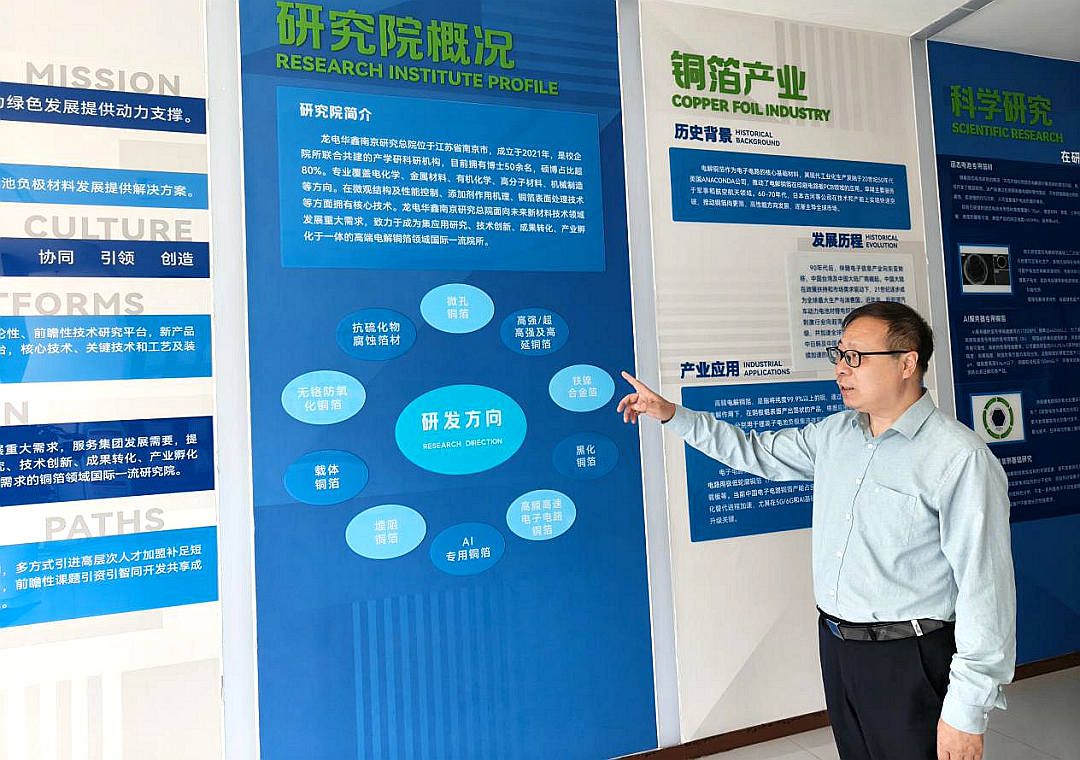
Here, there is a deep understanding of scientific research and a great care for talents.
As a “new resident of Lishui”, during the past three years in Lishui, Wang Shengxian’s most immediate impression was that this place truly understands research and cares about talents.
Throughout the journey, for Wang Shengxian, there were both hardships and warmth. From project application to policy coordination, all levels of departments in Lishui actively provided on-site services; guarantees such as housing for talents and enrollment for children were implemented one by one, allowing team members to stay and be stable; various industry-university-research collaboration activities brought university resources directly to the doorstep of enterprises.
“Working on material research in Lishui, one has access to resources, support and a positive environment.” He expressed his heartfelt admiration.
In 2023, he was selected as a high-level innovative talent under the “Zijinshan Talent Program” of Lishui District. In 2024, he was awarded the title of Expert Studio in Nanjing. In the same year, he was also selected as a “Chuangye Talent” in Jiangsu Province. Besides, he also held various social positions such as an expert member of the Copper Foil Branch of the China Electronics Association and an expert member of the Guangdong Standardization Committee. While engaging in technical work, he was also paving the way for the industry.

Starting from entering the industry across sectors, leading the way in tackling challenges, and eventually settling down in Lishui, Wang Shengxian did not have any earth-shattering slogans. Instead, relying solely on a strong “grasping difficult tasks” spirit, he turned a small piece of copper foil into something significant, and also blazed a new path for China’s high-end copper foil industry.
On this route, Lishui has provided a solid foundation for this “material breakthrough”. From the implementation of provincial major projects, to housing for talents, connecting industry-research-university collaborations, and policy support throughout the process… In a sense, Lishui itself is also a solid pipeline that supports this “invisible artery”.