Skip to content
In the north of the city in March, flowers create poetry. The spring breeze takes up the pen and also writes new stories.
Last week, the Science City of Jiangbei New District held its New Year celebration. This was the first major event after the Science City began construction. Over 600 representatives from universities, financial institutions and enterprises gathered together to discuss development and draw a blueprint, making a crucial move towards the future.

If we go back two months ago, the two major industrial parks, Renchuang Park and Pukou High-tech Zone, had just “joined hands” and merged. The name “Jiangbei New District Science City” entered the public’s view for the first time. People were full of curiosity about this new city: How could it be called a “city”? From building “parks” to building “cities”, just one character difference, what are the differences exactly?
These questions were difficult to answer at that time, but today, two months later, there is a clearer interpretation. At the meeting, the main person in charge of the Science City pointed out the differences between building “parks” and building “cities” with three sentences:
Building parks focuses on functional concentration, while building cities focuses on system collaboration; Building parks emphasizes project implementation, while building cities emphasizes ecological creation; Building parks focus on short-term output, while building cities focus on long-term resilience.
These three sentences are somewhat abstract, but if we extend the time axis and look back at the original appearance of this land, the answers are hidden in the growth pattern of the region.
Let’s start with 2012.
At that time, this area was still called Nanjing Software Park (West District). The first building of the park, Xingying Building, had just received its first foundation. Around it, there was only a stretch of fishpond and mudflat. As a temporary office for an aquaculture farm, the process of building the “park” began.
In 2015, the State Council approved the establishment of Nanjing Jiangbei New Area. Xingying Building was completed and put into use; one year later, the park was officially renamed “Industrial Technology Research and Innovation Park”. Since then, the words “research and innovation” have begun to be written into the development history of this land. In 2019, the Research and Innovation Park and the Software Park were re-integrated, and the management and service area increased to 23 square kilometers.
The plans were adjusted several times, the park’s name changed, and its area expanded, but a “unchanged” main thread always ran through it: focusing on research and innovation, gathering enterprises, expanding the industry, and creating a core bearing area for innovation and entrepreneurship in the northern part of the Yangtze River.


This is precisely the core logic behind the establishment of the “park” – regional development cannot be separated from the rise of industries. During the initial stage of exploration and advancement in the north of the city, the significance of the Research and Innovation Park might lie in facilitating functional concentration, enabling project implementation, and fostering the rapid growth and maturation of industries.
Following this main line, a “park” was built on a stretch of riverbank:
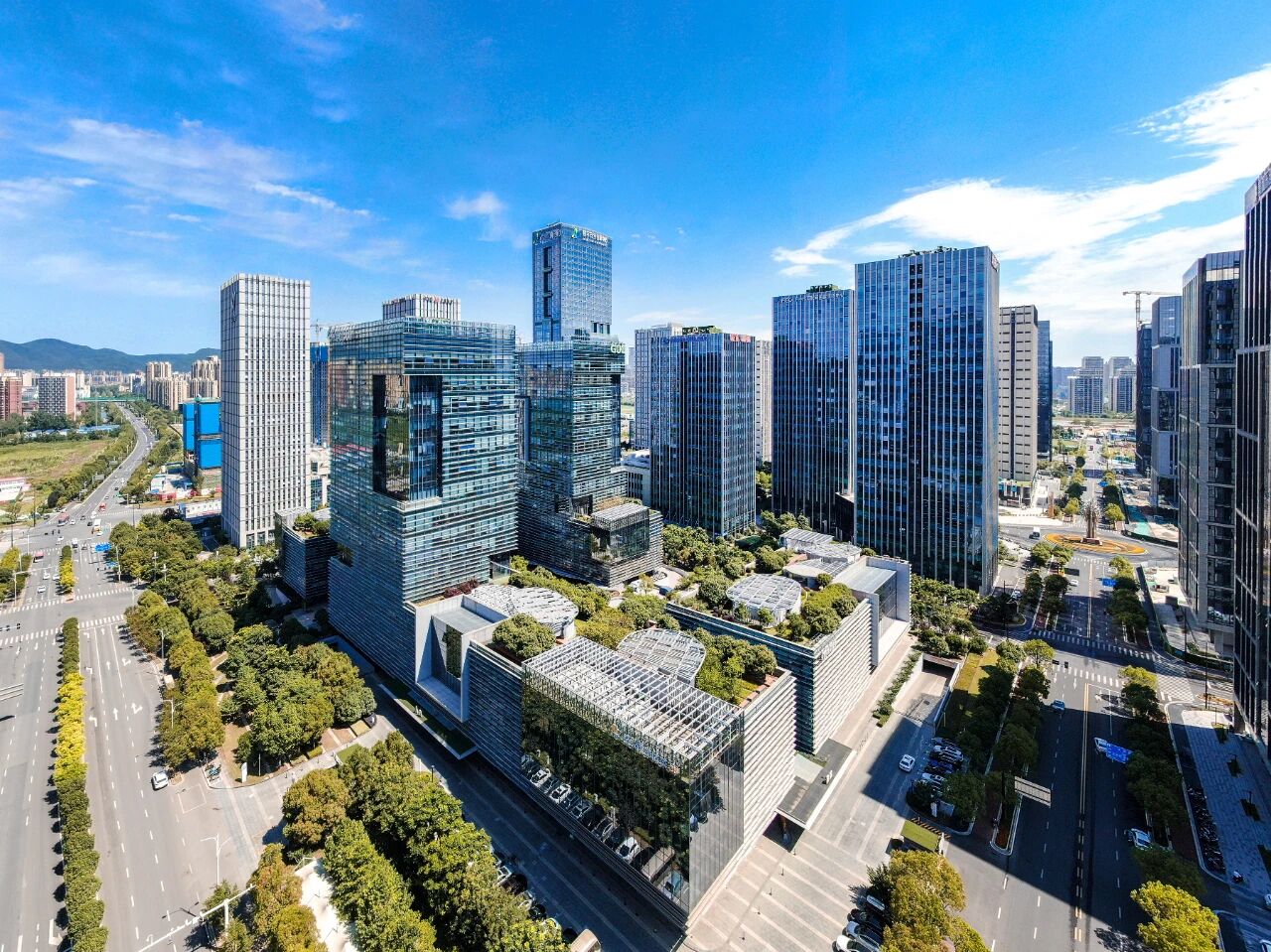
Over the past 10 years, the number of enterprises the Research and Innovation Park has increased by more than 400 times, with a compound growth rate of tax revenue exceeding 100%, and the construction area has exceeded 10 million square meters. Here, hundreds of high-rise buildings have been erected, thousands of overseas returnees have been gathered, nearly 10,000 enterprises have been landed, and 100,000 industrial personnel have been gathered. In the field of integrated circuit design, it has firmly held the leading position in the country, and a cluster of industries worth hundreds of billions has thus emerged.
From the smokestacks and grassy fields to the towering buildings, this is the story of Ranzheng Park. Looking back at the present, why build another science city?
Because of the “moment” of development: The park has grown to a certain stage, with tens of thousands of enterprises and talents pouring in. Everyone is calling for a new “evolution”. Of course, it is also because of the “trend” of strategy: Standing at the critical historical juncture of the “15th Five-Year Plan” launch, whether it is implementing the national and provincial deployments or responding to the intense competitive situation, Jiangbei urgently needs to “re-boost” the regional core competitiveness.

Advancing and improving, then how should this “city” be built? Many stories are being written.
For instance, a road.
In the Science City, there is a “Huigui Road”, which is less than 3 kilometers long but connects the intelligent computing center, the provincial research institute, the China Mobile Yangtze River Delta Innovation Center, the talent apartment, the Lechuanghui Stadium and the Sandscape OLE, among other landmarks. When work, study, leisure and consumption are all within walking distance, the “city” takes on a more vivid appearance. This is the integration and empowerment of industry, innovation and life.
For instance, cooperation among neighbors.
Not long ago, Chu Hang Technology and Guibuo Microelectronics jointly tackled the problem and achieved the global debut of a brand-new 4D satellite architecture radar; likewise, the embodied intelligent mobile welding robot developed by Jichu Intelligent Manufacturing also performed splendidly in the production workshop of Liye Transformer. More and more “neighbors” have become “team members”, and enterprises have moved from “clustering” to “coexistence”, which brings more impetus to industrial development.

For instance, the top ten industry tracks.
At the meeting, the Science City identified ten industry tracks: artificial intelligence, integrated circuits, intelligent sensors, silicon-based microdisplay, photonic chips, low-altitude economy, atomic-level manufacturing, satellite manufacturing, precision instruments, and new-generation information technology.
Why these? Because they point to the next decade. From manipulating atoms to manufacture everything, to chasing satellites into space, these cutting-edge tracks certainly require years of accumulation, but only by looking forward can we go further in the future…
The story of a road, witnessing the reconfiguration of space, “city-industry-people” are no longer separated; cooperation among neighbors is advancing, and ecological construction is also progressing, generating boundless vitality; the “steaming” ten major industry tracks are even a long-term layout’s courage, sowing new seeds for the future.
Three stories, precisely point to the key to building a “city” – system collaboration, ecological creation, and long-term resilience. When obscure and difficult-to-understand concepts are translated into reality, the future appearance of Jiangbei New District Science City gradually becomes clear, and it also enables us to clearly understand the differences between building a “park” and building a “city”:
If building a “park” is like drawing on a blank sheet of paper to complete the “from 0 to 1” aggregation;
Building the “city” means enriching this canvas further and achieving a breakthrough from “1” to “N” – breaking the single production attribute and making people the most prominent element.

If viewed from a higher perspective, the transition from “garden” to “city” holds even greater significance.
Currently, the Jiangbei New District Science City, which integrates the Research and Innovation Park and Pukou High-tech Zone, covers a total management service area of 42 square kilometers. Spatially, it connects mountains and rivers, and in terms of industry, it collaborates and progresses together. The rise of such a “city” is capable of accommodating more cutting-edge technologies to take root and more innovative talents to settle down, becoming a “new engine” for the further elevation of the innovation level of Jiangbei’s new main city.
Looking further ahead, a science city is also a key hub for Jiangbei to deeply integrate into the construction of the Yangtze River Delta’s scientific and technological innovation community and actively link the global innovation network. As more scientific and technological resources flow in and more enterprises link up with the world, the opening up will bring about a larger space for imagination.
From an initial stretch of a riverbank, to a park, and then to a new city, this reshaping has just begun.