Skip to content
On November 12th, the world’s first system-level ethical vertical domain large model “Wenda” was officially released at Southeast University, marking an important transformation in China’s AI ethical governance field from “passive compliance” to “active co-construction”.
This large model is dedicated to serving as an ethical thinking partner and decision support system for users, helping research institutions, technology enterprises, ethical review agencies, policymakers, and the public to gain insights into diverse values and safeguard common good in complex technological and social issues.
Respond to real needs
At present, general-purpose large models generally have problems such as “illusion creation” and opaque ethical logic. The development of “Wu Dao” is precisely to systematically respond to this practical demand. As a professional ethics large model, it has constructed a functional matrix covering the entire process of ethics governance, including five core directions:
The first is ethical risk assessment and auditing. By systematically identifying potential risks such as fairness, privacy and security in algorithms, it achieves pre-emptive prevention and control of ethical risks.
The second is ethical dilemma simulation and decision deduction. By constructing highly realistic moral scenarios, it assists users in conducting multi-perspective deduction and decision optimization.
The third is ethically aligned auxiliary design, which transforms value principles into executable and quantifiable engineering and technical standards and algorithm norms, providing a full-chain solution from concept embedding to compliance implementation for artificial intelligence products.
Fourth, dynamic knowledge base and case teaching. The model integrates global ethical norms and typical cases, supports intelligent search and situational learning, and enhances the efficiency of professional knowledge acquisition.
Fifth, it is committed to exploring the frontiers of ethics and innovating paradigms. Through in-depth literature mining and theoretical analysis, it assists scholars in understanding the laws of ethical development and promotes the leapfrog upgrading of academic research paradigms.
Overall, “Wenda” can systematically identify and assess various risks in AI applications and propose operational governance paths based on the Chinese context.

It is worth mentioning that “Wu Dao” deeply integrates traditional Chinese philosophical wisdom with Western ethical frameworks in its theoretical construction, forming an analytical system with distinct Chinese characteristics.
The model not only integrates the essence of Confucianism, Buddhism and Taoism, but also fully aligns with the current domestic laws and regulations. It can serve as an intelligent assistant for the government to formulate policies, for regulatory authorities to conduct ethical reviews, for enterprises to develop compliance, and for the public to popularize science. When outputting suggestions, the model clearly marks the reasoning basis and the source of ethical principles, and indicates the uncertainty of the conclusion, embodying the collaborative concept of “human in the loop” and the governance approach of explainable artificial intelligence.
Cross-disciplinary platform joint research and development
Overall, “Wenda” can systematically identify and assess various risks in AI applications and propose operational governance paths based on the Chinese context.
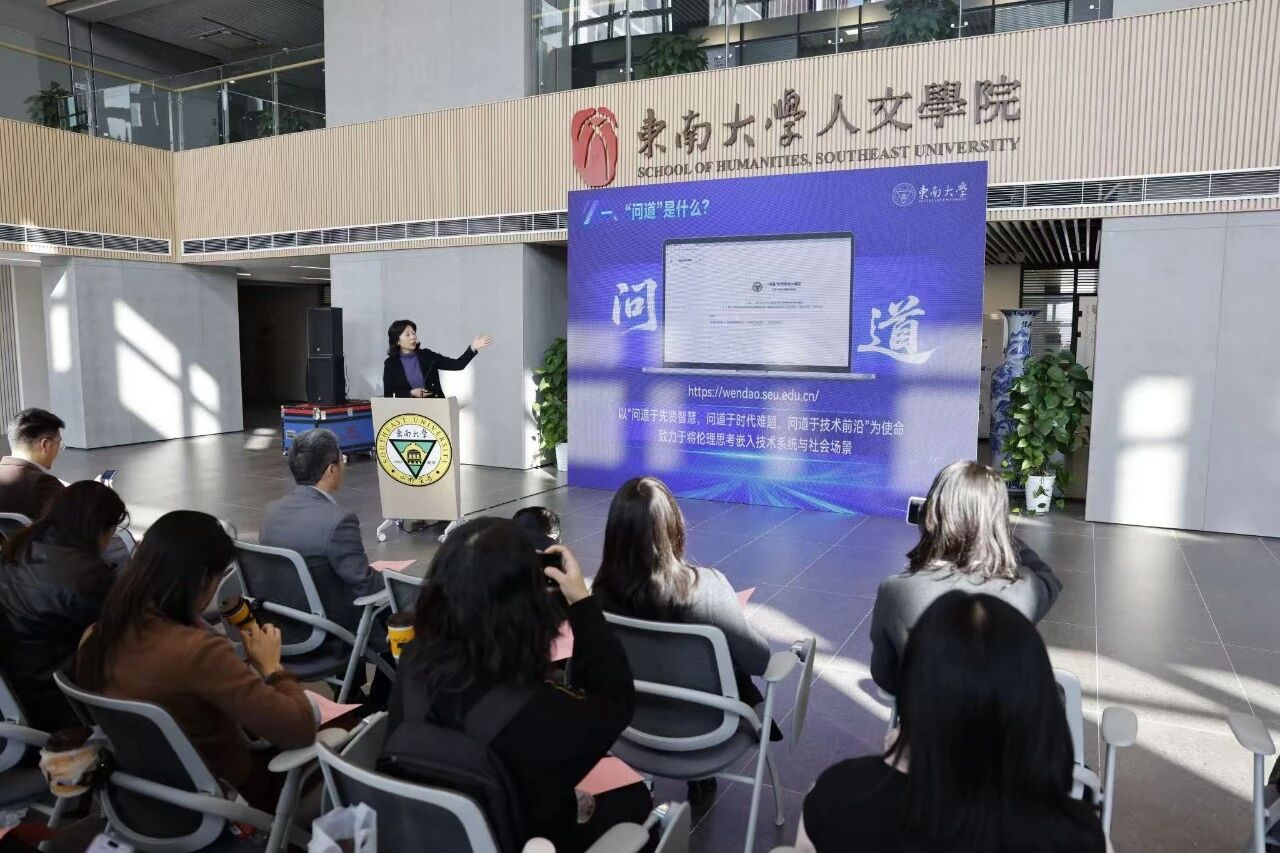
This model was led by Wang Jue, the director of the AI Ethics Laboratory at Southeast University and a professor at the School of Humanities. It was jointly developed with interdisciplinary platforms such as the National Key Laboratory of Mobile Communications, the National Key Laboratory of Millimeter Waves, the Frontier Science Center for Mobile Information Communication and Security of the Ministry of Education, and the Jiangsu Provincial Think Tank for Moral Development within the university. This collaborative structure fully embodies the distinct feature of Southeast University’s “intersection of liberal arts, science and engineering”, forming a full-chain research and development path from ethical theory, data support to communication technology and artificial intelligence.
Wang Jue stated, “Seeking the Way” is rooted in the Chinese tradition of “seeking the Way” and “inquiring about learning”, aiming to explore the logical and ethical boundaries of technological development and provide a systematic solution for building a reliable intelligent governance system. This interdisciplinary practice not only reflects Southeast University’s integration and innovation in the construction of new liberal arts, but also provides a path reference with Chinese characteristics for the global ethical governance of artificial intelligence.
In the future, “Wenda” will continue to optimize its human-computer interaction mechanism, focus on the systematic and gradual nature of development, open feedback channels to experts and users, form a virtuous closed loop of model iteration, and further expand its in-depth application in scenarios such as scientific research, industry, and education, contributing wisdom to the coordinated development of artificial intelligence and social ethics.