Skip to content
On January 31st, the establishment conference of the China Interventional Medicine Industry Ecological Alliance, titled “Starting from Interventional Medicine and Approaching the Infinite Realm”, was held in Jiangbei New District. Academia Sinica’s academicians Teng Gaojun and Zheng Hairong, the Party Secretary and Director of Jiangbei New District and Pu Kou District, Lu Weidong, the Vice President of Southeast University and the Standing Member of the University’s Party Committee, Qiu Haibo, the President of the China Pharmaceutical Supervision and Administration Research Association, Zhang Wei, the Party Secretary and Head of the Party Committee of Dongrui Medical, Song Qi, and the Party Committee Member and Deputy Director of Jiangbei New District’s Party Committee and Management Committee, Wang Wei, attended the event.
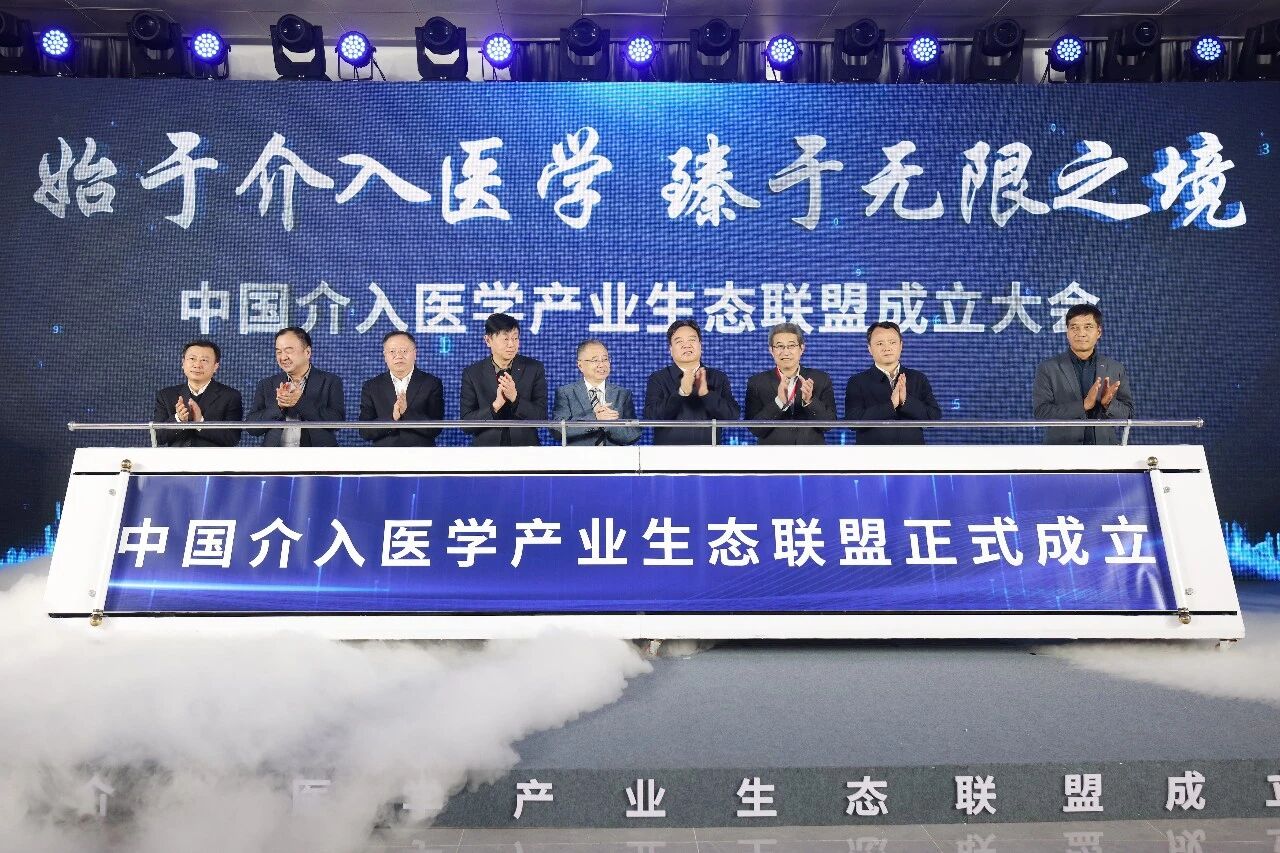
Interventional medicine, as one of the most dynamic and transformative frontiers in modern medicine, has profoundly changed the diagnosis and treatment models of numerous diseases with its distinctive features of being minimally invasive, precise, and efficient. In 2023, the New District collaborated with Southeast University to jointly establish the National Medical Research and Industry-Education Integration Innovation Platform for “Interventional Medical Engineering,” dedicated to breaking through common core key technologies in the industry’s development. In 2024, the New District and Southeast University signed a new round of comprehensive strategic cooperation agreements, with several major scientific and technological innovation platforms, including the National Medical Research and Industry-Education Integration Innovation Platform for “Interventional Medical Engineering,” unveiled and stationed in Jiangbei. A cluster of innovation resources from Southeast University is accelerating its gathering in the area.
At the same time, last year, the New District formally signed a strategic cooperation agreement with Nanjing University, fully advancing the construction of the School of Pharmacy and the School of Green Chemical Engineering, and actively building a vibrant and transformation-efficient chemical and biomedical discipline cluster.
The China Interventional Medical Industry Ecosystem Alliance launched this time is led by the National Medical Research and Industry-Education Integration Innovation Platform for “Interventional Medical Engineering” at Southeast University and jointly established with various stakeholders. It aims to integrate innovation resources in China’s interventional medicine field, build a closely linked innovation chain combining “government, industry, academia, research, medicine, regulation, and finance,” and enhance the product innovation and R&D capabilities of member units. In the future, the alliance will further accelerate the transformation and industrialization of interventional medical scientific and technological achievements in the New District.
Teng Gaojun stated that the establishment of the Interventional Medical Industry Ecosystem Alliance aims to build an ecological platform that links medicine, research, enterprises, government, and business in an open, collaborative, and value-co-creating manner. The alliance will strive to overcome the challenges of deep integration in “medicine-engineering interdisciplinary” collaboration, enhance the synergistic evolution of “regulatory science” with technological innovation and commercialization, break through the “internationalization” challenges for Chinese products, and cultivate an integrated industrial ecosystem of “industry-academia-research-application-investment.” He expressed hope that all member units would join hands, break down barriers with an open mindset, overcome difficulties through cooperation, and plan for long-term development together.
Zheng Hairong noted that with the development of artificial intelligence technology and imaging navigation technology, interventional medicine is entering a new stage of development, giving rise to more new formats, models, and enterprises. Against this backdrop, establishing the Interventional Medical Industry Ecosystem Alliance is of critical importance. He looks forward to the alliance, under the guidance of many experts and scholars, bursting with vitality, promoting the integration of major platforms in medicine, industry, education, and research with capital, fostering innovation in the medical device industry, and advancing the cause of serving human health.
Lu Weidong emphasized that interventional medicine, as a frontier field of precision medicine and minimally invasive technology, represents the most dynamic and promising platform for innovation in medicine-engineering interdisciplinary collaboration. Relying on the National Medical Research and Industry-Education Integration Innovation Platform, the establishment of the China Interventional Medical Industry Ecosystem Alliance by bringing together government, industry, academia, research, medicine, regulation, finance, and other stakeholders is not only a timely response to the trends of the era and national needs but also a key initiative to integrate strategic scientific and technological forces and build a high-level, open innovation and entrepreneurship ecosystem. He hopes the alliance will focus on national strategies, bravely shoulder the mission of scientific and technological self-reliance, deepen the integration of research and production to create a synergistic innovation ecosystem, and adopt a global perspective to continuously enhance its competitiveness and cooperation capabilities internationally.
Qiu Haibo pointed out that Southeast University has always taken serving national strategies and people’s health as its mission, vigorously promoting the construction of major medical disciplines and interdisciplinary integration. Relying on the National Medical Research and Industry-Education Integration Innovation Platform, the university has actively positioned itself at the forefront of interventional medicine. The establishment of the alliance aims to unite multiple forces and build a collaborative innovation ecosystem. He hopes the alliance will become a source of cutting-edge technologies, a connector for industrial collaboration, a testing ground for institutional innovation, and a bridgehead for international cooperation, fully facilitating the transformation channel from basic research to clinical application.
Zhang Wei stated that the establishment of the Interventional Medical Industry Ecosystem Alliance will build a closer communication bridge between regulatory authorities and the industry, helping to better understand industrial development needs and formulate more scientific and reasonable regulatory policies, while also providing clearer guidance for corporate innovation and R&D. He hopes the alliance will strengthen collaborative innovation to promote industrial upgrading, enhance exchanges and cooperation to boost international influence, reinforce talent cultivation to solidify the development foundation, and improve combined drug-device training to elevate industry standards.
On the spot, the first phase of the Jiangbei New District Medical-Engineering Integration Fund with a scale of 300 million yuan and the Jinhua Interventional Medical Industry Fund with a scale of 500 million yuan were launched. These two funds will empower more innovative interventions in the medical field to emerge in the new district. The joint R&D center in the field of drug-device combination between Southeast University and Qilu Pharmaceutical Co., Ltd., and the Nanjing Concept Validation Center (in the field of drug-device combination products of the affiliated Zhongda Hospital of Southeast University) were simultaneously inaugurated.
At the meeting, Teng Gaojun delivered a keynote speech on “The Current Situation and Trends of Interventional Medicine”; several industry experts and key enterprise representatives engaged in dialogue and exchanges on the themes of “Innovation Opportunities and Challenges of Medical-Engineering Integration” and “Medical-Engineering Innovation Trends and Opportunities in China”, sharing their research results and work experiences in the field of medical-engineering cross-disciplinary integration.
The relevant platform leaders of Southeast University, the relevant departments and bureaus of Jiangbei New District, experts and scholars in the field of intervention medicine, and enterprise representatives participated in the event.