Skip to content
At present, it is the crucial time for spring farming preparations. In the Shende Plant Factory in Nanjing National Agricultural High-tech Zone, there is no soil here and no need for sunlight. However, vegetables and green plants can still grow quietly on the layers of cultivation racks… Recently, a reporter entered this largest plant factory in Jiangsu Province to explore the unique scenery of “technological spring farming”.

The yield of one crop of lettuce in 35 days is 50 times that of open-field cultivation.
Entering the lettuce cultivation area, six layers of planting racks are neatly arranged, resembling a three-dimensional “green workshop”. The root systems of each lettuce plant are firmly planted in biodegradable sponge, and they drink precisely proportioned nutrient solutions; above them, specially designed LED lights shine on demand, constantly day and night.

“Normally, it takes 60 days to harvest lettuce in the fields. But here, we can put it on the market in just 35 days,” said Xu Guijun, the agricultural technology director of Shendian Nanjing Energy Holding Co., Ltd. He explained that by precisely controlling factors such as light, temperature and humidity, the growth cycle of lettuce has been shortened by nearly 20 days.

The improvement in efficiency goes far beyond this. Xu Guijun said that the utilization rate of lettuce in plant factories exceeds 95%, while that in traditional fields is only 60%-70%; vertical planting increases the yield per unit area by more than 50 times compared to traditional fields, while the labor input is only one-fifth of that in traditional fields.
Currently, this factory supplies about 100 kilograms of lettuce per day, and with full production capacity, it can reach 240 kilograms. The lettuce is directly loaded onto trucks after being harvested, achieving “half-day delivery”, and is mainly sold to surrounding cities such as Shanghai and Nanjing.
The chrysanthemums here bloom all year round in fear of high temperatures. Next to the lettuce, there is a colorful field of chrysanthemums.

“We currently cultivate 12 varieties, all of which are produced on a custom basis,” said Xu Guijun. Angelica flowers take approximately two months to grow from seedling stage to full bloom, and the flowering period lasts for four months. Each plant can produce over 200 flowers, and the daily output exceeds 100,000 flowers.
Viola plants are sensitive to high temperatures and cannot be grown in the open field during summer. However, this is precisely the “prime time” for the plant factory. “Since we can’t grow them outside in summer, they are still indispensable for the decoration of dishes in hotels. Therefore, summer actually becomes our peak delivery period,” Xu Guijun explained. Currently, the plant factory delivers approximately 3,000 violets per day, with a peak of 15,000 per day. The main supply area is hotels in Shanghai and surrounding cities.
Green vegetables are grown under the green photovoltaic panels on the roof.
This 1,100-square-meter plant factory is filled with a sense of technology. Parameters such as temperature, humidity, and light are precisely controlled. Different spectral light is set for plants at different growth stages to achieve continuous production throughout the year. The biodegradable sponge substrate and medical-grade nutrient solution have been tested by the EU SGS and are free of pesticides and heavy metals, meeting the no-wash standard and can be directly eaten.
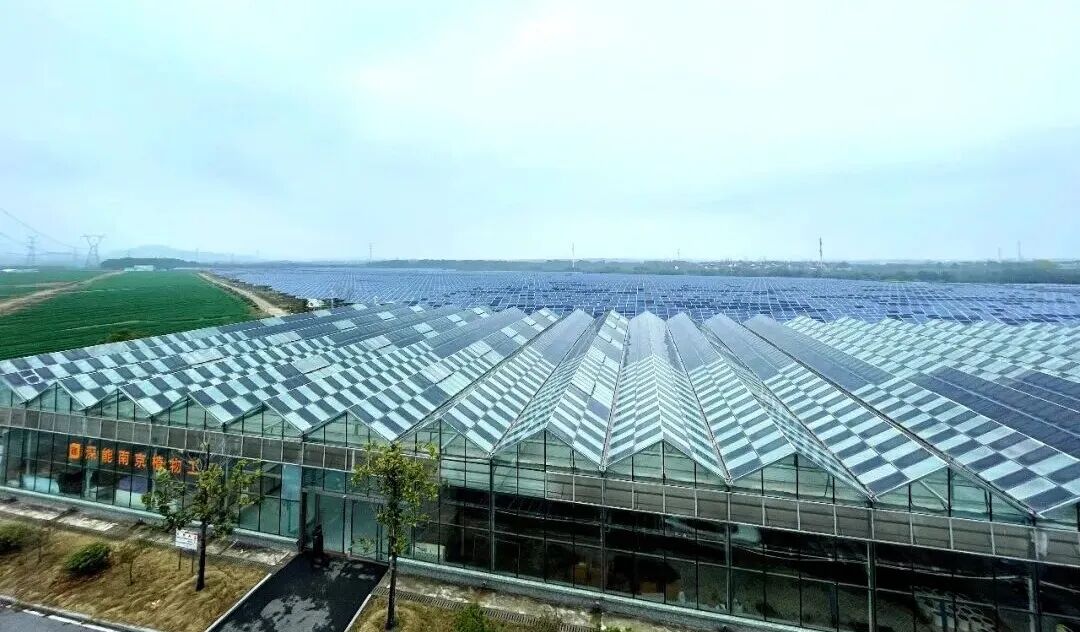
The most remarkable feature is located above the roof. Solar photovoltaic panels have been installed on top of the factory, creating a “agriculture and solar power complementation” model – generating electricity through the panels and conducting green planting beneath them. “Solar power supplies energy for the plant factory, and the photovoltaic panels can generate over 24 million kilowatt-hours of electricity annually. Meanwhile, the plant factory only uses 300,000 to 400,000 kilowatt-hours of electricity throughout the year.” Xu Guijun stated that the surplus electricity is fed back into the grid, providing clean energy and achieving dual benefits of “power generation on the panels and vegetable cultivation beneath them”. With technological support, this factory can achieve an annual output value of 1.5 million yuan. “In the future, we will continue to expand the market and ensure sustainable development goes even further.”