Skip to content
Step 1: Put the crushed corn into a centrifuge tube
Step 2: Add the extractant and gently mix
Step 3: Suck out the sample and drop it into the test card
Beep – the result is out
This is not in a laboratory but on the spot at a grain purchasing point in Henan Province.
In the past, when testing for aflatoxin, samples had to be sent to laboratories in other places, and the round trip would take several days. And now? I stood by the grain pile and did it myself. The result would be clear in just a few minutes. I immediately have a clear idea of whether there are any problems with the purchased grain. A person in charge on the spot spoke with a sense of reassurance.
This seemingly simple yet highly accurate and efficient detection method is driven by Nanjing Weice Biotechnology Co., LTD. (hereinafter referred to as “Nanjing Weice”) from the new District. After ten years of hard work, Nanjing Weice has grown from a start-up to a leader in the domestic rapid toxin testing field. With its technology, it has brought its laboratory to the fields, warehouses and production lines. Standing at the new starting point of its tenth anniversary, it is not content – more new products are on the way, and a new journey has just begun.
01 A “Little White Card”
In the field of rapid food testing, especially for the detection of contaminants in grains, oils and feeds, there have long been two major technical routes: enzyme-linked immunosorbent assay (ELISA) and colloidal gold method.
The former is proficient in quantification and can accurately measure “how much poison there is”. The latter excels in its simplicity, being ready to use immediately after disassembly and requiring no professional background. However, against the backdrop of the increasingly urgent demand for high-throughput, high-sensitivity, and on-site detection in modern agriculture and the food industry, the market is calling for a solution that combines both.
The turning point occurred in 2015.
It was the second year since Nanjing Weicai was established. A comprehensive detection platform named “Time-resolved Fluorescence Quantitative Immunochromatography Technology” was born in the company’s laboratory.
“Our technology not only enables precise quantification but is also easy to operate. It can be easily mastered without the need for professional inspectors.” ” Xiao Liwen, the general manager and chairman of the company, introduced.
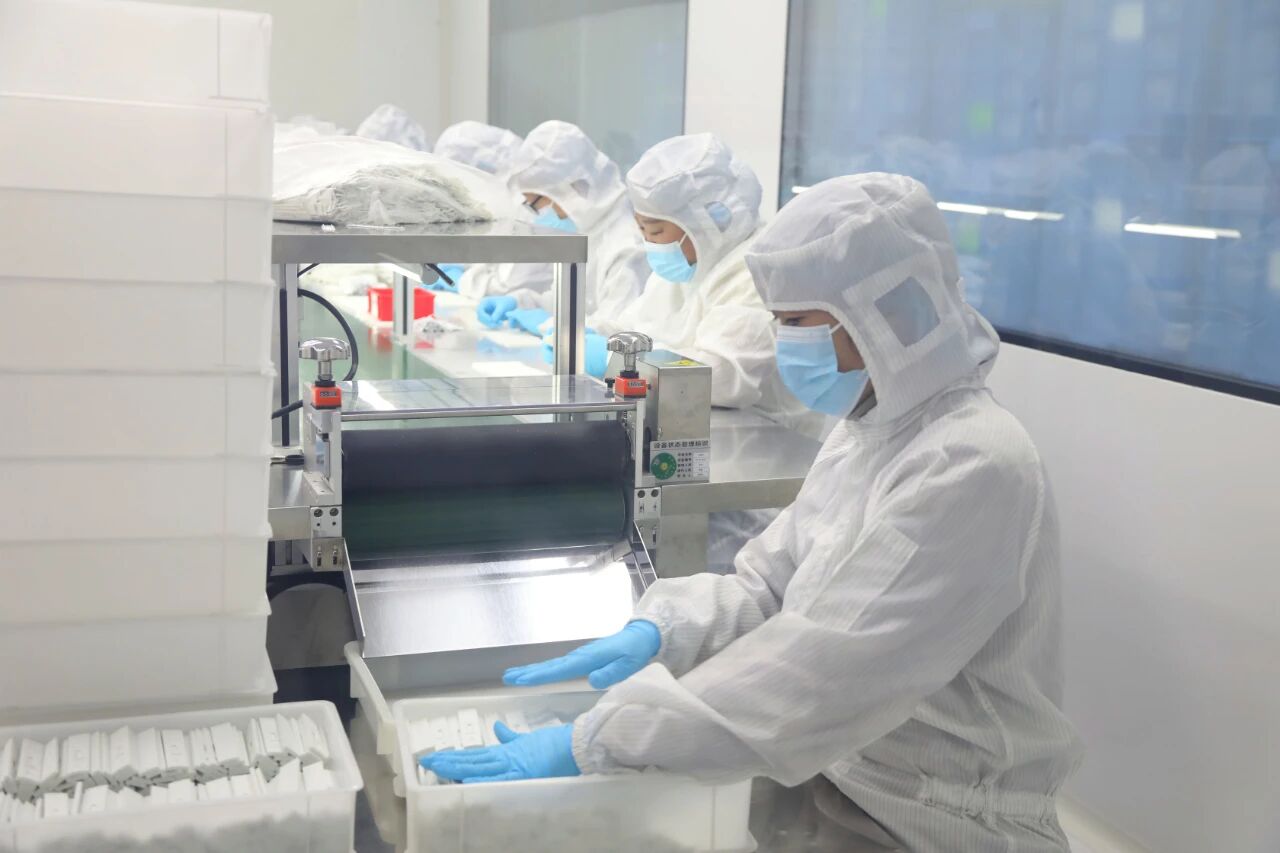
In the company’s experimental workshop, pure white rectangular test cards are being assembled and formed on the assembly line, ready to be sent across the country. This is one of the core products developed based on this technology – the time-resolved fluorescence quantitative detection card for aflatoxin. The card design is extremely simple, featuring a sample loading area and a display area. Just drop in the sample and the result can be quickly read.
Its features are very clear: fast, accurate, simple, and quantifiable. Xiao Liwen emphasized.
At present, Nanjing Weice has successfully developed a number of rapid mycotoxin detection products covering fields such as grain and oil, feed, dairy products, and Chinese medicinal materials, including common toxins such as aflatoxin, vomitoxin, zazalenone, and ochratoxin, all of which can be detected with a single card.

With this “hardcore” technology, Nanjing Weice has quickly gained industry recognition and has now reached stable cooperation with many large grain, oil, food and feed enterprises such as Sinograin, COFCO, Yihai Kerry, Luhua, Muyuan and CP. Last year, the company’s annual sales reached nearly 100 million yuan, marking that its technology and products have been fully verified by the market.
02 Three “Ten-Year Plans”
The core of an enterprise is people. Besides the excellent performance of “one small card, one hundred million yuan in sales in a year”, Xiao Liwen is even more delighted to tell the story of the team.

In 2008, Xiao Liwen, who was studying under Professor Sun Xiulan, a renowned expert in the field of food safety in China, successfully completed her master’s research project at the School of Food Science and Technology of Jiangnan University. After graduation, he joined a food safety rapid testing company in Shanghai and began to establish a research and development team and invest in dairy rapid testing technology.
Based on a solid theoretical foundation and rich experience accumulated in the business world, in 2014, Xiao Liwen embarked on his entrepreneurial journey.

“Before, all I had to do was consider whether the technology was good or not and whether the product was feasible. But after starting my own business, I suddenly had a lot of things to do. I not only had to focus on cost control and the development of the research team, but also had to visit clients and expand the market by myself.” ” Xiao Liwen still has a deep impression of the hardships at the beginning of his entrepreneurial journey.
In 2016, the company had just launched its rapid test card product and was making every effort to expand its customer base among large groups. A large flour group with a branch factory in Suqian, due to the severe contamination of wheat by vomitoxin that year, needed to increase the inspection of raw materials upon their entry into the warehouse. Therefore, it ordered quantitative rapid testing products for vomitoxin from Nanjing Weice.
Those orders totaled ten boxes, with a total value of less than 10,000 yuan, but they were of great significance to us. After the product was packaged, Xiao Liwen drove it to Suqian overnight and handed it over to the customer. We are very confident in our technology. As long as it can be used by customers, we are sure to gain recognition. Xiao Liwen said.
Later, this client indeed became a repeat customer of the company, and the expansion of large group clients became increasingly smooth. By then, the company’s development was on the right track. The team gradually expanded to 130 people, and orders came in one after another.
From just three people at the beginning of its establishment to a scale of over 130 people today, the development of Nanjing Weice has been like a speeding train, advancing rapidly. At present, the company not only has products such as rapid detection cards, card reading devices and software systems, but also launched fully automatic detection instruments at the end of last year, further liberating manual labor and improving detection efficiency.
But the determination for development does not end here. In Xiao Liwen’s plan, there are three “ten-year plans”. The first one has been completed, which is to become a leading enterprise in the domestic rapid toxin detection field within ten years.
In the second decade, the focus will be on further expanding the business scope and striving to become the “leader” in the domestic food safety field. In the third decade, we must continue to broaden our development perspective and rank among the top three in the global food safety field.
Now, at the foot of Longwang Mountain, a new decade is about to begin.