Skip to content
The first national major scientific and technological infrastructure in China’s information and communication field – the Future Network Test Facility – has passed the national acceptance and been officially put into operation. This marks the “birth” of China’s Internet “national treasure” in Nanjing.
Compared with the traditional Internet, the most prominent feature of facilities is end-to-end determinism. Liu Yunjie, an academician of the Chinese Academy of Engineering and the overall project leader of the Future Network Test Facility, introduced.
Entering the 21st century, the traditional Internet has gradually exposed many problems, and countries around the world have been making plans for basic research in the field of future networks. In 2010, experts such as Liu Yunjie suggested to the state that the “Future Network Test Facility Project” be planned. In 2015, the facilities were built in Nanjing. On December 3rd, the acceptance committee appraised that the project had fully achieved its construction goals and agreed that the project had passed the national acceptance. It has produced a series of significant technological breakthroughs, accelerating the process of key technology research and development, transformation and application of achievements, and industrial cultivation and development in China’s information and communication field.

Take the “China Sky Eye”, another major scientific facility, as an example. The “China Sky Eye” generates hundreds of terabytes of data every day. Tests show that it takes 699 days to transmit 72TB of data through the traditional Internet (10-megabit dedicated line), but only 1.6 hours with the 100G deterministic network of the Future Network test facility.
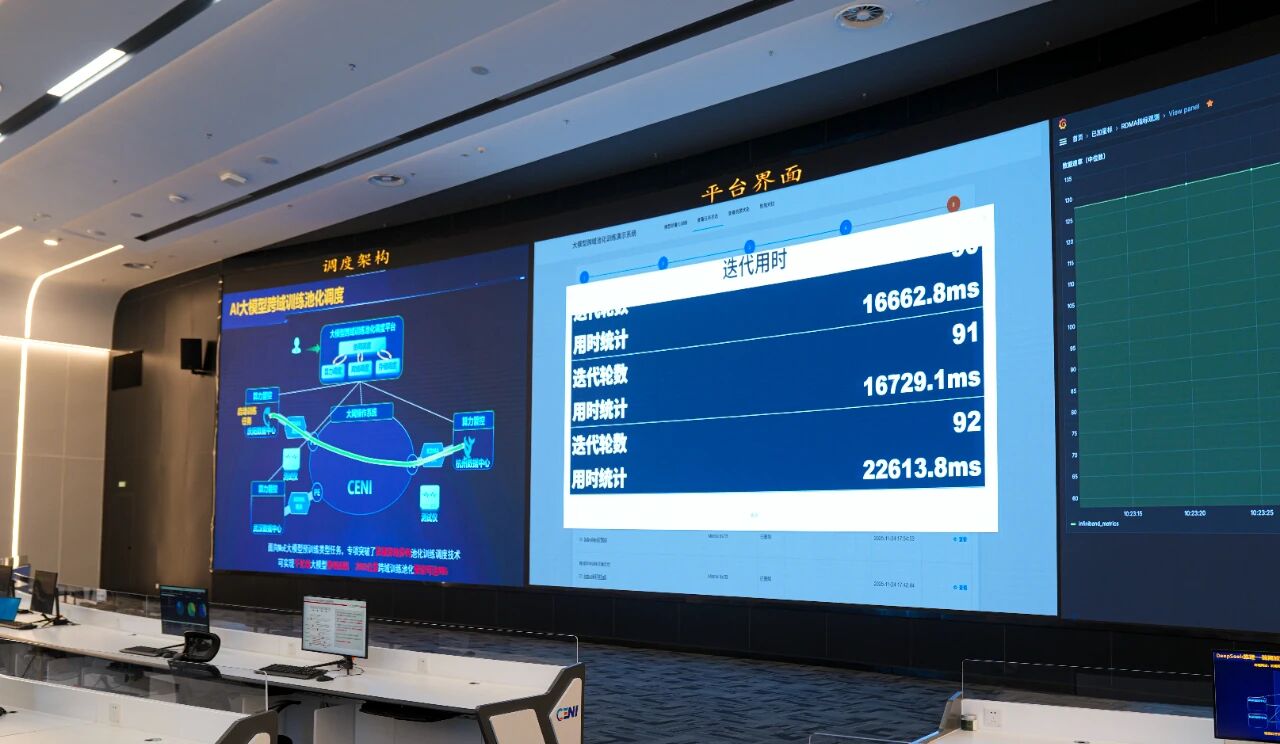
The facilities can also be connected to computing power centers across the country to form a computing power network, supporting cross-domain training of large models. The computing efficiency ratio of a 2,000-kilometer cross-domain pool can reach 98% of that of a single data center, significantly reducing time and computing power costs and solving the problem of “scarcity, diversity, and dispersion” of high-end computing power in China.
At the test site, the reporter saw that with the support of facilities, the three cities of Qingyang, Wuhan and Hangzhou worked together to train the large model, and the training time for each iteration was stable at around 16 seconds. After being shut down and returning to the traditional network, the time immediately rose to 33 seconds.
Universities, research institutions and enterprises can all conduct Internet research and verification through open experimental facilities. During the trial operation period, the project has successfully supported 120 innovative experiments, covering major national strategies, cutting-edge technological innovations, and applications in emerging industries.
Wu Hequan, an academician of the Chinese Academy of Engineering and co-director of the National Acceptance Committee for Future Network Test Facilities, said that the current application of computing power is still in its infancy and various unknown challenges may emerge in the future. It is expected that through the future network test facilities, a platform with strong fault tolerance and support for innovative exploration can be built for scientific researchers, accelerating the transformation and application of technological achievements and promoting the high-quality development of the real economy.